

Introduction
Dental implant surgery requires careful planning because implants must be positioned within the jawbone while avoiding important anatomical structures, such as nerves, blood vessels, and sinus cavities.
Some dentists use custom-made surgical guides to help position implants, while others perform the procedure freehand.
But does using a surgical guide actually make dental implant surgery safer?
Research shows that guided implant surgery generally improves placement accuracy. However, greater accuracy does not automatically mean fewer complications or higher implant survival rates. [1, 2]
Understanding how surgical guides work, their potential benefits, and their limitations can help you make informed decisions when considering dental implants in Mexico.
What Is a Surgical Guide?
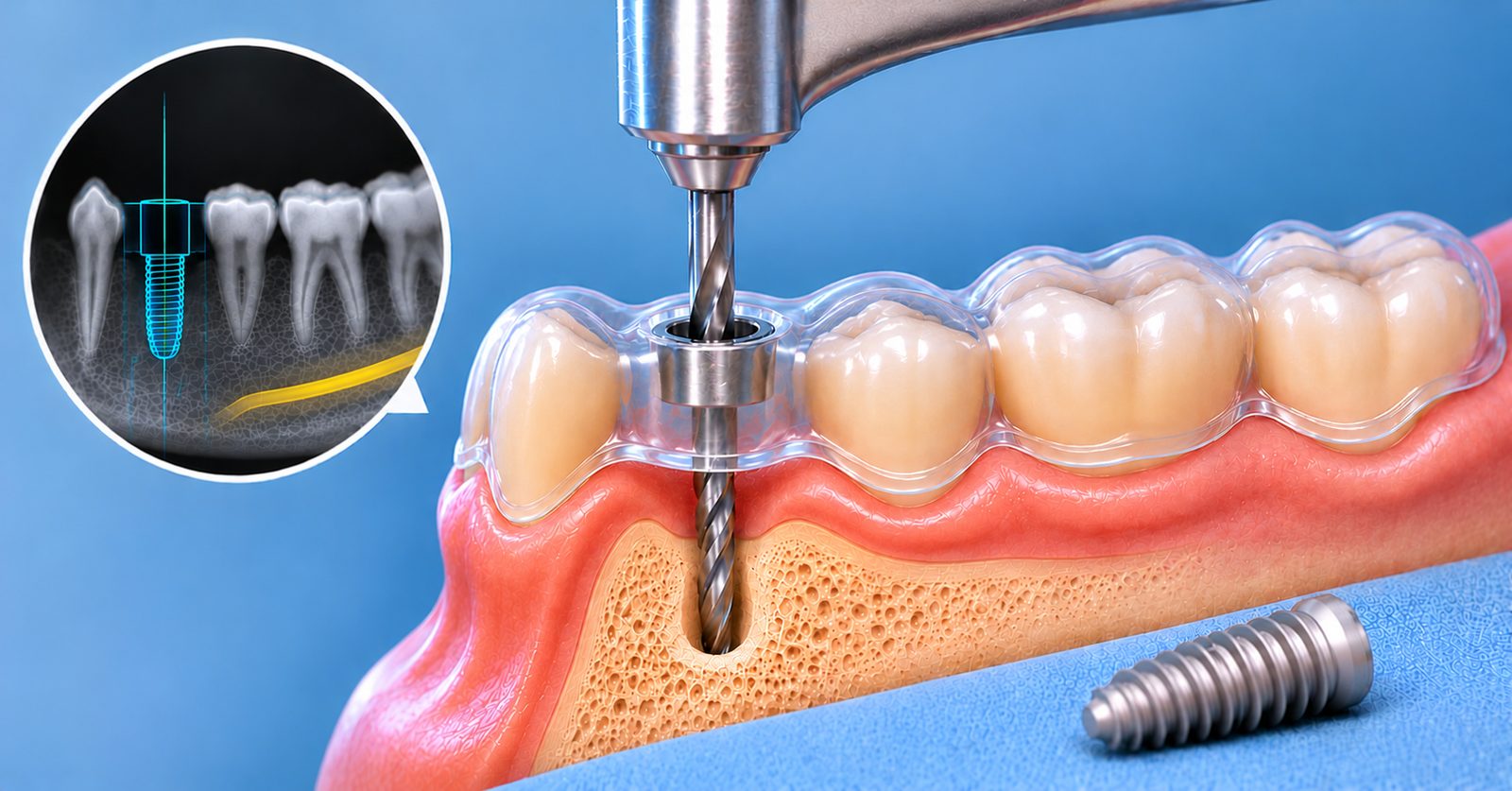
A surgical guide is a custom-made device designed to help the dentist place dental implants in predetermined positions.
The process typically begins with a cone-beam computed tomography (CBCT) scan, which produces three-dimensional images of the jawbone and surrounding anatomical structures.
Using specialized software, the dentist plans the intended position, angle, and depth of each implant.
A surgical guide is then fabricated to help transfer that plan to the patient's mouth during surgery.
Depending on the surgical system, the guide may direct the drilling instruments, implant placement, or both.
The purpose is to improve the accuracy and predictability of implant positioning.
How Can Surgical Guides Improve Safety?
1. Helping Avoid Nerve Injuries
One of the important anatomical structures dentists must consider during implant surgery is the inferior alveolar nerve, which runs through the lower jaw.
If an implant or surgical instrument damages this nerve, the patient may experience:
- Numbness of the lower lip or chin.
- Tingling or altered sensation.
- Pain or unusual sensations.
- Temporary or, in some cases, permanent sensory changes.
Three-dimensional imaging allows the dentist to identify the nerve's location and plan implant placement at an appropriate distance. A surgical guide can help transfer that plan during surgery.
Important: A surgical guide does not guarantee that nerve injuries will be prevented. Imaging interpretation, planning accuracy, appropriate safety margins, and surgical technique remain essential. [1, 3]
2. Helping Avoid Sinus Complications
Dental implants placed in the upper back jaw may be close to the maxillary sinuses. These air-filled spaces are located above the upper premolars and molars.
If an implant extends into the sinus or damages surrounding structures, complications may occur. Depending on the circumstances, these can include sinus membrane injury, inflammation, or sinus-related problems.
Using CBCT imaging, the dentist can evaluate the available bone and the position of the sinus before surgery. A surgical guide may help the dentist reproduce the planned implant position.
However, guided surgery does not eliminate sinus-related risks, and some patients may require additional procedures, such as sinus augmentation, before implant placement.
3. Improving Implant Positioning
Dental implants must be placed in positions that provide adequate support for the final restoration.
Poor implant positioning can contribute to problems involving:
- The design or fit of the final crown or bridge.
- Access for cleaning around the implant.
- The distribution of chewing forces.
- The appearance of the final restoration.
- The proximity of implants to adjacent teeth or anatomical structures.
A 2025 systematic review examining 55 studies found that computer-assisted implant surgery generally produced more accurate implant positioning than freehand surgery. [1]
This improved accuracy can be particularly valuable in complex cases involving limited bone or multiple implants. However, accuracy is only one factor influencing the overall success of implant treatment.
Does Guided Surgery Reduce Surgical Complications?
This is where the distinction between surgical accuracy and clinical safety becomes especially important.
Although guided surgery generally improves the accuracy of implant placement, research has not consistently demonstrated that it significantly reduces overall complication rates compared with freehand surgery.
A 2026 umbrella review examined 13 systematic reviews comparing guided and freehand implant placement.
The researchers found that guided surgery improved placement accuracy, while implant survival and marginal bone loss were generally comparable between techniques.
The analysis also suggested that guided surgery might reduce certain surgical risks, particularly in complex cases. However, the difference in overall complication rates was not statistically significant. [2]
What does this mean for patients?
Guided surgery may provide advantages in specific clinical situations, but it should not automatically be considered safer for every patient.
Both guided and freehand techniques can produce successful outcomes when appropriately planned and performed by experienced surgeons. [2]
Can Something Go Wrong When Using a Surgical Guide?
Yes. Although surgical guides are designed to improve accuracy, they introduce additional steps into the treatment process. Errors can occur during imaging, digital planning, guide fabrication, or surgery.
Incorrect Digital Planning
A surgical guide is designed according to the treatment plan created by the dentist. If the planned implant position is incorrect, the guide may reproduce that error. A guide cannot compensate for an inappropriate treatment plan.
Poor Guide Fit
A surgical guide must fit securely and remain stable during surgery. If it does not fit correctly or moves during drilling, the actual implant position may differ from the planned position. This can be particularly challenging in patients who have lost all their teeth because the guide cannot be supported by natural teeth.
Manufacturing or Technical Errors
Inaccuracies during scanning, digital processing, or guide fabrication can affect how precisely the guide transfers the surgical plan.
Unexpected Surgical Conditions
During surgery, the dentist may discover differences in bone quality, inadequate implant stability, or other conditions that require adjustments. In some situations, the surgeon may need to modify the original plan or continue without the surgical guide.
A 2019 scientific review emphasized that errors can occur at multiple stages of guided implant surgery and that proper training, verification, and surgical experience are essential for minimizing risks. [3]
Is Guided Surgery More Accurate Than Freehand Surgery?
Generally, yes. Scientific research has consistently demonstrated that computer-assisted implant placement can improve the accuracy of implant positioning.
A 2025 systematic review reported the following average deviations between planned and actual implant positions:
| Surgical Technique | Average Angular Deviation |
|---|---|
| Freehand surgery | 7.46° |
| Partially guided surgery | 5.94° |
| Fully guided surgery | 2.57° |
A smaller angular deviation means the implant was placed closer to its planned angle.
These results represent averages from multiple studies and do not predict the outcome of an individual procedure. The review also found that even guided implant placement can deviate from the planned position. [1]
Greater accuracy can be beneficial, but it does not guarantee the absence of complications.
Are Surgical Guides Particularly Important for All-on-4, All-on-6, or All-on-8?
Full-arch implant procedures involve placing multiple implants to support an entire upper or lower set of replacement teeth.
These procedures require careful planning because the implants must be positioned to support the planned prosthesis while accommodating the patient's available bone.
In some cases, implants are intentionally tilted to take advantage of available bone and avoid important anatomical structures.
Surgical guides may be especially useful when:
- Multiple implants must be placed at specific positions or angles.
- Available bone is limited.
- Implants are planned near important anatomical structures.
- The treatment involves complex restorative requirements.
- A fixed provisional bridge is planned shortly after surgery.
However, All-on-4, All-on-6, and All-on-8 procedures do not always require a surgical guide.
Experienced surgeons may perform these procedures using freehand techniques. The decision should be based on the patient's anatomy, the complexity of the treatment, the planned restoration, and the surgeon's clinical judgment.
Research comparing guided and freehand implant surgery across different clinical situations should not automatically be interpreted as evidence specific to every full-arch procedure.
Does a Surgical Guide Guarantee Successful Dental Implants?
No. A surgical guide helps with implant positioning, but successful treatment depends on much more than the surgical technique.
Bone quality and quantity: The jawbone must provide adequate support for the implants.
General health: Certain medical conditions and medications may affect healing and treatment planning.
Gum health: Active periodontal disease and poor oral hygiene can increase the risk of complications.
Implant stability: Implants must achieve sufficient stability, particularly when immediate loading is planned.
Restoration design: The final crown or bridge must be properly designed to function with the implants.
Long-term maintenance: Regular dental examinations, professional maintenance, and daily cleaning remain essential.
A surgical guide cannot eliminate these factors or guarantee that an implant will integrate successfully with the surrounding bone.
Should You Choose a Dental Clinic That Uses Surgical Guides?
The availability of surgical guides can be useful information when comparing dental clinics in Mexico.
However, the use of guided surgery alone should not determine which clinic you choose.
A clinic that uses surgical guides is not automatically better or safer than one that performs freehand implant placement.
Consider the surgeon's qualifications, experience, treatment planning, and ability to explain why a particular technique is appropriate for your case.
A clinic should also be able to explain how it evaluates the jawbone, identifies anatomical risks, and plans the final restoration.
Questions to Ask Your Dental Clinic
Before undergoing dental implant surgery in Mexico, consider asking:
- Will my implants be placed using guided or freehand surgery?
- Will a 3D CBCT scan be used to evaluate my jawbone and plan implant positions?
- Why is the recommended surgical technique appropriate for my case?
- How will the surgeon identify and avoid important anatomical structures?
- If a surgical guide is used, how will its fit and stability be verified?
- What happens if the surgical plan needs to change during the procedure?
- Does the quoted treatment price include surgical planning and guide fabrication?
The answers can help you better understand the proposed treatment and compare the information provided by different clinics.
Frequently Asked Questions
Can dental implants be placed safely without a surgical guide?
Yes. Freehand implant placement is an established surgical approach. When performed by an appropriately trained and experienced surgeon, with suitable planning and patient selection, freehand surgery can produce successful outcomes.
Does guided implant surgery eliminate the risk of nerve damage?
No. Surgical guides may help the dentist reproduce planned implant positions near important anatomical structures, but they do not eliminate the possibility of nerve injuries.
Is guided implant surgery less painful?
Not necessarily. Postoperative discomfort depends on several factors, including the extent of surgery, whether incisions or bone grafting are required, and the patient's individual healing response. Some guided procedures can be performed using less invasive techniques, but guided surgery does not automatically mean less pain.
Is guided surgery always more expensive?
Not always. Guided surgery may involve additional costs for digital planning, guide fabrication, and specialized equipment. Some clinics include these services in their implant packages, while others charge separately.
Can a dentist switch from guided to freehand surgery during the procedure?
Yes. If the guide does not fit correctly or unexpected surgical conditions arise, the surgeon may need to modify the treatment approach. Any change should be based on the patient's anatomy, surgical findings, and clinical judgment.
Does every All-on-4 patient need a surgical guide?
No. All-on-4 procedures can be performed using guided or freehand techniques. The most appropriate method depends on the patient's anatomy, the complexity of the procedure, and the surgeon's experience.
The Bottom Line
Surgical guides can improve the accuracy of dental implant placement and may offer advantages in complex surgical cases.
However, research has not conclusively demonstrated that guided surgery produces fewer complications or better long-term implant survival than freehand surgery in every situation.
Both techniques can be effective when supported by careful planning and appropriate surgical expertise.
When considering dental implants in Mexico, focus on understanding your treatment plan, the surgeon's qualifications, and why a particular surgical approach has been recommended for your individual needs.
Scientific References
The following peer-reviewed scientific publications provide supporting evidence for the information presented in this article.
- [1]Werny JG, et al. (2025). Freehand vs. computer-aided implant surgery: A systematic review and meta-analysis—Part 1: Accuracy of planned and placed implant position. International Journal of Implant Dentistry. DOI: 10.1186/s40729-025-00622-w Read Study
- [2]Tomar S, et al. (2026). Comparing the clinical outcomes of guided and freehand dental implant surgery: An umbrella review of systematic reviews and meta-analyses. Journal of Prosthetic Dentistry. Read Study
- [3]Tatakis DN, Chien HH, Parashis AO. (2019). Guided implant surgery risks and their prevention. Periodontology 2000, 81(1), 194–208. DOI: 10.1111/prd.12292 Read Study
Medical Disclaimer
This article is provided for educational purposes only and is not intended to replace professional dental advice, diagnosis, or treatment.
The most appropriate implant placement technique depends on each patient's individual anatomy, oral health, medical history, and treatment needs.
Consult a qualified dental professional for a personalized evaluation before undergoing dental implant surgery.