

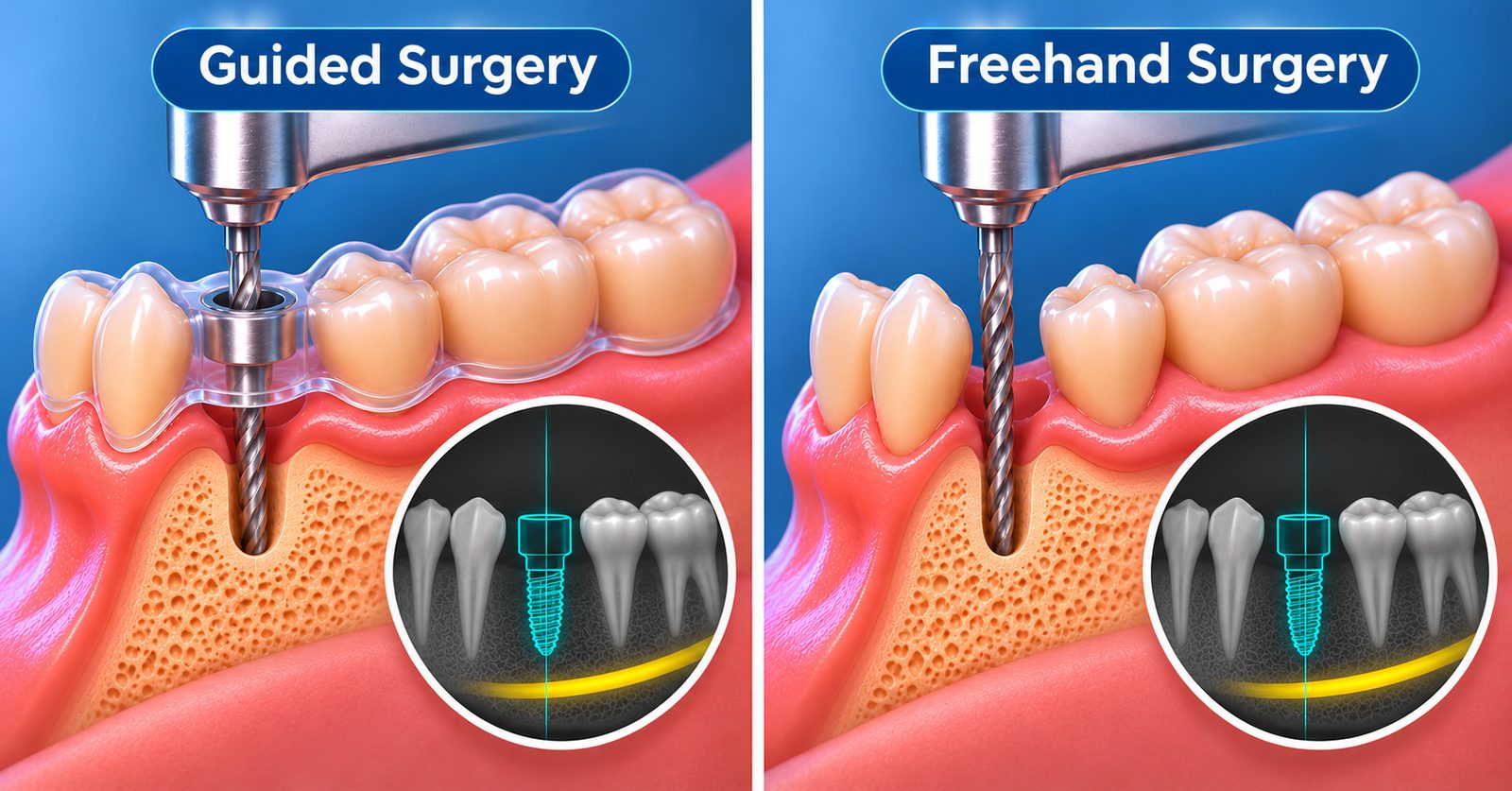
When researching dental implants, you may come across two different surgical approaches: guided implant surgery and freehand implant surgery.
Both techniques are used to place dental implants into the jawbone. The main difference is how the dentist determines and controls the implant's position during surgery.
Understanding these approaches can help you ask better questions when comparing dental clinics in Mexico.
What Is Guided Implant Surgery?
Guided implant surgery uses a custom-made surgical guide to help the dentist position dental implants according to a treatment plan developed before surgery. [2]
The planning process typically involves a 3D CBCT scan, which provides detailed images of the jawbone and surrounding anatomical structures.
Using specialized software, the dentist plans the intended position, angle, and depth of each implant.
A surgical guide is then created to help transfer that digital plan to the patient's mouth during surgery. [2]
Depending on the guide design and surgical system, the guide may control the drilling sequence, implant placement, or both. [1, 2]
Potential Advantages of Guided Implant Surgery
- Helps transfer the planned implant positions to the surgical site. [2]
- May improve the accuracy of implant positioning. [1, 2, 4]
- Can be particularly helpful when placing multiple implants.
- Helps the dentist plan around important anatomical structures, such as nerves and sinuses.
- May allow less invasive surgical approaches in appropriately selected cases.
Potential Limitations
- Requires additional planning, equipment, and guide fabrication.
- May increase treatment costs.
- A poorly fitting or improperly positioned guide can affect accuracy.
- The dentist may need to modify the surgical plan if unexpected conditions are discovered during surgery.
- A surgical guide does not eliminate surgical risks or guarantee implant success. [1, 3]
What Is Freehand Implant Surgery?
Freehand implant surgery is a technique in which the dentist places implants without using a physical surgical guide to direct the instruments.
The dentist determines implant positioning using the preoperative treatment plan, anatomical landmarks, clinical measurements, and professional judgment.
Freehand surgery does not necessarily mean surgery without digital planning.
Dentists may still use CBCT scans and 3D software to evaluate the jawbone and plan implant positions before performing freehand surgery.
Potential Advantages of Freehand Implant Surgery
- Allows the surgeon to make adjustments during the procedure.
- Does not require fabrication of a surgical guide.
- May reduce certain planning and equipment costs.
- Can be effective when performed by an appropriately trained and experienced implant surgeon. [4]
Potential Limitations
- Implant positioning depends heavily on the surgeon's ability to transfer the treatment plan accurately.
- It may be more difficult to reproduce precise planned implant angles and positions. [1, 2]
- Complex cases may present additional challenges, especially when available bone is limited or important anatomical structures are nearby.
Guided vs. Freehand Implant Surgery: What's the Difference?
| Feature | Guided Surgery | Freehand Surgery |
|---|---|---|
| 3D CBCT planning | Commonly used | Can also be used |
| Physical surgical guide | Yes | No |
| Implant positioning | Assisted by a guide | Controlled directly by the surgeon |
| Accuracy | Generally improves agreement with planned positions [1, 2, 4] | More dependent on the surgeon's ability to reproduce the plan |
| Surgical flexibility | May require guide removal or modification to change the plan | Allows direct adjustments during surgery |
| Additional equipment | Usually required | No surgical guide required |
| Cost | May be higher | May be lower |
| Implant success | Not guaranteed | Not guaranteed |
Is Guided Surgery Better Than Freehand Surgery?
Guided implant surgery generally provides greater accuracy in transferring planned implant positions to the jawbone. [1, 2, 4]
However, greater placement accuracy does not automatically translate into higher implant survival rates or better long-term outcomes for every patient. [3, 4]
Successful implant treatment depends on several factors, including:
- The quality and quantity of available jawbone.
- Appropriate implant selection and positioning.
- The surgeon's training and experience.
- The design of the final restoration.
- The patient's general and oral health.
- Proper healing and long-term maintenance.
Both guided and freehand approaches can produce successful results when appropriately planned and performed. [3, 4]
Do All-on-4, All-on-6, and All-on-8 Procedures Require Surgical Guides?
No. Surgical guides are not mandatory for every full-arch implant procedure.
All-on-4, All-on-6, and All-on-8 treatments can be performed using guided or freehand techniques.
The most appropriate approach depends on the patient's anatomy, the planned implant positions, the type of restoration, and the surgeon's experience.
In some cases, particularly when implants must be placed at specific angles or when available bone is limited, guided surgery may offer important advantages.
However, experienced surgeons may also achieve successful outcomes using freehand techniques. [4]
Does Guided Implant Surgery Cost More in Mexico?
Guided implant surgery may involve additional expenses related to digital planning, surgical guide fabrication, and specialized equipment.
Some dental clinics include these services in their implant treatment packages, while others charge separately.
When comparing dental implant prices in Mexico, ask whether the quoted price includes surgical planning and any surgical guide that may be used.
Questions to Ask Your Dental Clinic
Before undergoing dental implant surgery, consider asking:
- Will my implants be placed using guided or freehand surgery?
- Will a 3D CBCT scan be used to plan my implant positions?
- Why is this surgical approach recommended for my particular case?
- How experienced is the surgeon with this technique?
- If a surgical guide is used, is its cost included in my treatment quote?
- What happens if the surgical plan needs to change during the procedure?
The Bottom Line
Both guided and freehand implant surgery are established approaches to dental implant placement.
Guided surgery can improve the accuracy of implant positioning, while freehand surgery allows the surgeon to make direct adjustments during the procedure.
The most important consideration is not simply whether a clinic uses a surgical guide, but whether the surgical approach is appropriate for your individual needs and supported by careful planning and professional expertise.
Scientific References
The following peer-reviewed scientific publications provide supporting evidence for the information presented in this article.
- [1]Werny JG, et al. (2025). Freehand vs. computer-aided implant surgery: A systematic review and meta-analysis—Part 1: Accuracy of planned and placed implant position. International Journal of Implant Dentistry. Read Study
- [2]Gargallo-Albiol J, et al. (2020). Fully Guided Versus Half-Guided and Freehand Implant Placement: Systematic Review and Meta-analysis. International Journal of Oral & Maxillofacial Implants. Read Study
- [3]Yogui FC, et al. (2020). Comparison Between Computer-Guided and Freehand Dental Implant Placement Surgery: A Systematic Review and Meta-Analysis. International Journal of Oral and Maxillofacial Surgery. Read Study
- [4]Tomar S, et al. (2026). Comparing the Clinical Outcomes of Guided and Freehand Dental Implant Surgery: An Umbrella Review of Systematic Reviews and Meta-Analyses. Journal of Prosthetic Dentistry. Read Study
Medical Disclaimer
This article is provided for educational purposes only and is not intended to replace professional dental advice, diagnosis, or treatment.
The most appropriate implant placement technique depends on each patient's individual anatomy, oral health, medical history, and treatment needs.
Consult a qualified dental professional for a personalized evaluation before undergoing dental implant surgery.